

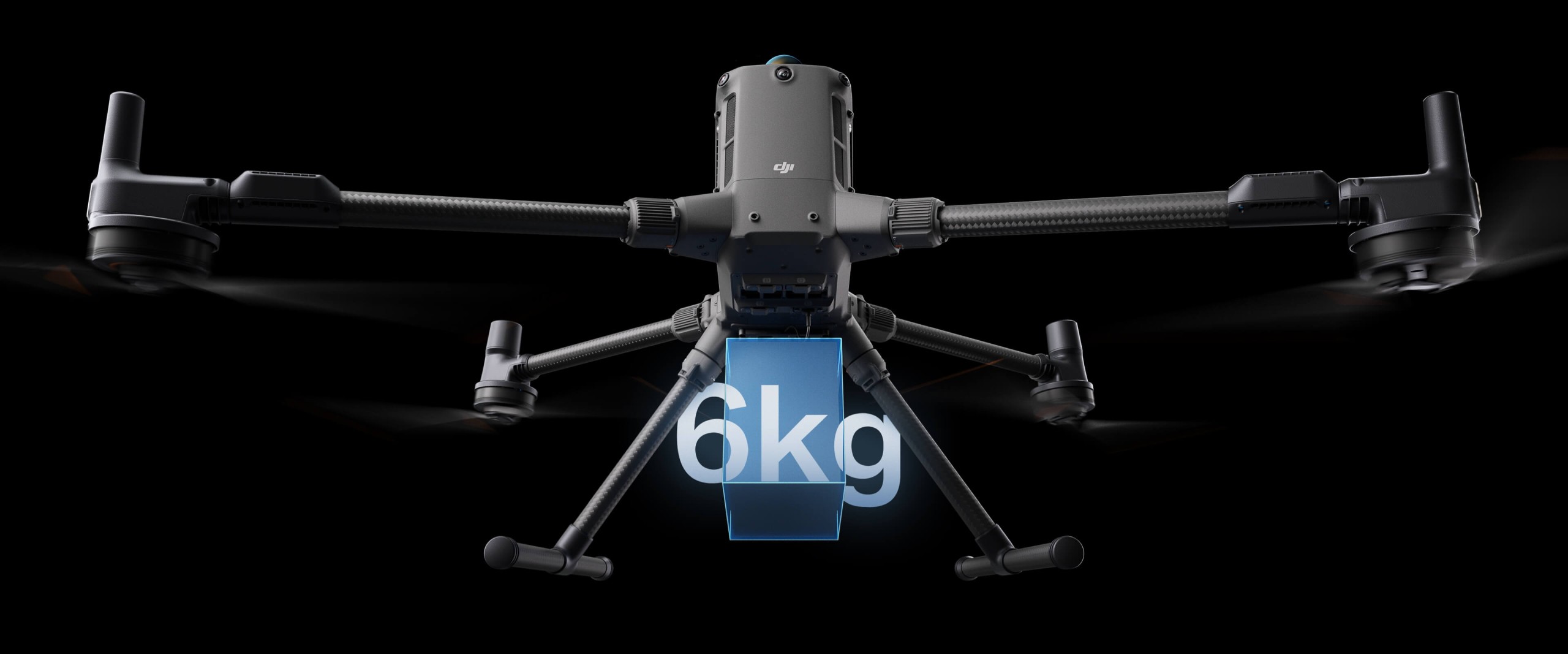
Built for versatility, the Matrice 400 supports a wide range of operational scenarios thanks to its robust payload capacity. Operators can switch between a single downward gimbal or a dual-gimbal setup, with a third gimbal port positioned underneath for added flexibility. With a 6 kg payload limit and four external E-Port V2 connectors, the aircraft can carry multiple sensors or tools—up to seven payloads simultaneously—making it adaptable for many types of missions.
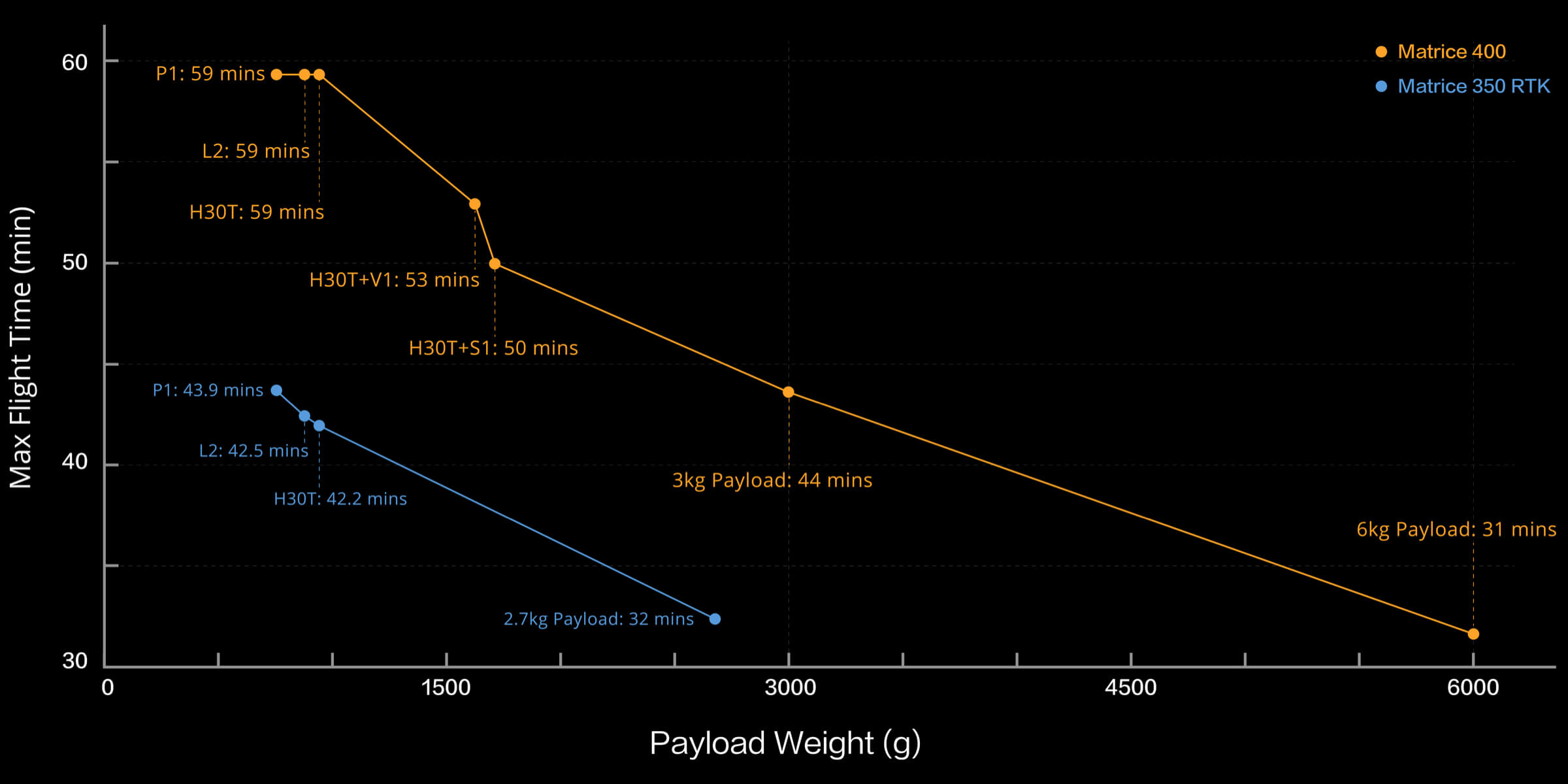
Calculate the expected flying time of the Matrice 400 considering its payload configuration.
The Matrice 400 meets an IP55 protection rating, enabling dependable performance in harsh conditions such as heavy dust or rain. It also maintains stable operation across a wide temperature range, from –20°C to 50°C (–4°F to 122°F), ensuring reliability in both hot and cold environments.
Equipped with rotating LiDAR, precision millimeter-wave radar, and low-light fisheye imaging sensors, the Matrice 400 provides exceptionally accurate obstacle detection. It can identify small objects—like thin power lines—even in steep or complex terrain. The sensing system maintains strong performance in difficult weather, including rain and fog, offering increased safety for missions conducted in challenging environments.
The O4 Enterprise transmission architecture enables image transmission up to 40 km, supported by a ten-antenna array on the aircraft and a high-gain phased-array antenna system on the remote controller.
Whether operating in dense urban areas or remote regions, the Matrice 400 maintains stable connectivity through sub-2G frequency support and automatic switching to the best available carrier network when paired with two DJI Cellular Dongle 2 units.
The Matrice 400 includes an integrated video relay system that allows one drone to fly at higher altitude and act as a communication bridge for another aircraft operating farther away. This configuration significantly extends overall transmission range, making the platform ideal for search-and-rescue operations and inspections in mountainous or obstructed environments.
The Matrice 400 uses a combination of rotating LiDAR, millimeter-wave radar, and full-color, low-light fisheye sensors to achieve precise, omnidirectional positioning. This fusion sensing enables the aircraft to operate safely near reflective surfaces like glass buildings or wind turbine blades, and ensures it can return safely even from complex environments such as mountain slopes, bridge edges, or narrow urban corridors.
Full-Color Vision Assist uses the drone’s four low-light fisheye sensors to provide enhanced visual awareness, improving situational safety and helping operators maintain orientation in challenging lighting conditions.
The Matrice 400 can automatically recognize people, boats, vehicles, and other objects during routine flights or search-and-rescue tasks, thanks to the combined imaging capabilities of the Zenmuse H30 Series. Its ability to switch between optical and thermal modes expands mission versatility. Along with powerful tracking features, the system also supports high-resolution grid photography for detailed data collection.